We are based on the local area and look at the worldHomepage - English
Hon Hai Group
Homepage
America
Mexico
Europe
Czech Republic
Hungary
Slovakia
Stakeholders
Materiality Assessment---Double Materiality Assessment
Overview of Double Materiality Assessment
Stage
Step
Specific operations
1: Identify major issues
1.1 Identification of Sustainability Issues
In identifying sustainability issues, Hon Hai benchmarked its performance against international standards to ensure comprehensiveness in its selection of material issues. These standards include the Global Reporting Initiative (GRI) and the Sustainability Accounting Standards Board (SASB). Hon Hai also referenced the sustainability practices of leading peers in the electronics manufacturing services (EMS) and original design manufacturing (ODM) industries to determine the scope of relevant issues. By evaluating issues across environmental, social, and governance dimensions, combined with considerations of the Group's internal management and business strategies, the Group ultimately identified 20 material issues for further stakeholder research.
1.2 Identification of key stakeholder groups
To ensure that Hon Hai's materiality analysis reflects the concerns of the Group's various stakeholders, we first identified relevant internal and external stakeholders. Key internal stakeholders include the Group's Board of Directors, employees, and senior management (first- and second-tier management). External stakeholder groups include customers, investors, and suppliers. We also included government agencies, media and public relations, non-governmental organizations (NGOs), community groups, public associations, research institutions, and other relevant internal and external stakeholder groups.
2: Analyze the impact of major issues
2.1 Survey stakeholders to assess the impact of selected issues
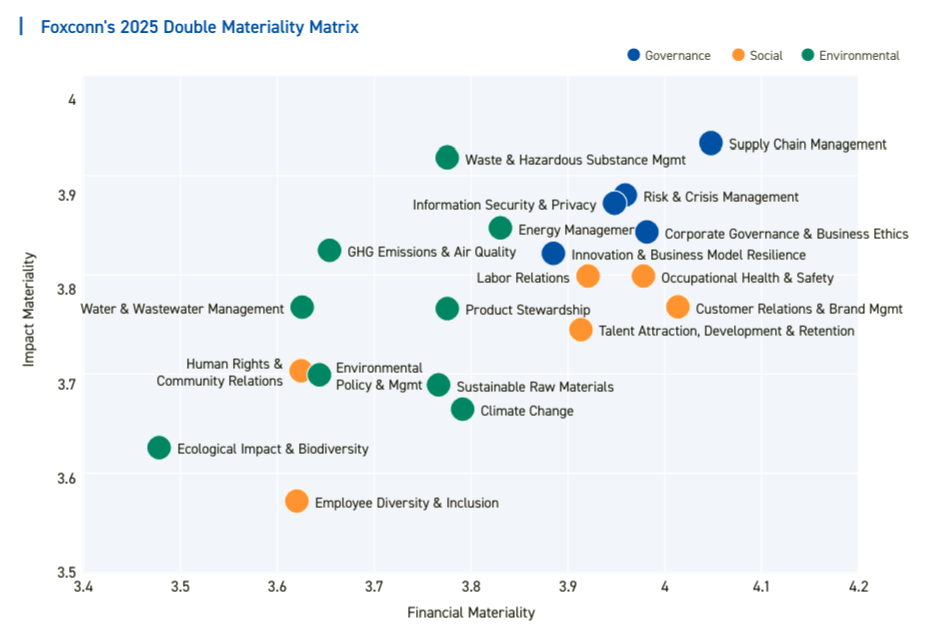
Hon Hai conducted a stakeholder survey and asked survey respondents to rate the impact of each issue on Hon Hai on a scale of 1-5, where 1 represents the lowest impact and 5 represents the highest impact.
To gain a deeper understanding of each stakeholder group's perspective on the positive and negative impacts of the 20 selected material issues, Hon Hai also asked participants to select up to three of the most significant positive and negative issues.
2.2 Analyze the survey results
The Group uses the questionnaire results as one reference input, combining them with information obtained through existing governance and management mechanisms (such as risk management, customer and supply chain management, regulatory compliance, major incidents, and grievance feedback) to comprehensively determine the year's material issues and their priority management focus―serving as the basis for report disclosure and annual management action planning.
20 relevant issues identified by Hon Hai Group

Environmental Issues9

Sustainable Materials & Product Management
Waste & Hazardous Substance Management
Energy Management
GHG Emissions & Air Quality
Climate Change
Water Resources & Wastewater Management
Ecological Impact & Biodiversity
Product Stewardship
Environmental Policy & Management


Social Issues6

Labor Relations
Employee Diversity & Inclusion
Talent Attraction, Development & Retention
Human Rights & Community Engagement
Customer Relations & Brand Management
Occupational Health & Safety

Governance Issues5

Corporate Governance & Business Ethics
Risk & Crisis Management
Information Security & Privacy Protection
Innovation and Business Model Resilience
Sustainable Supply Chain Management
Material Topics Overview